MiniWasp
Ephemeral messaging with on-server moderation and encrypted video calls
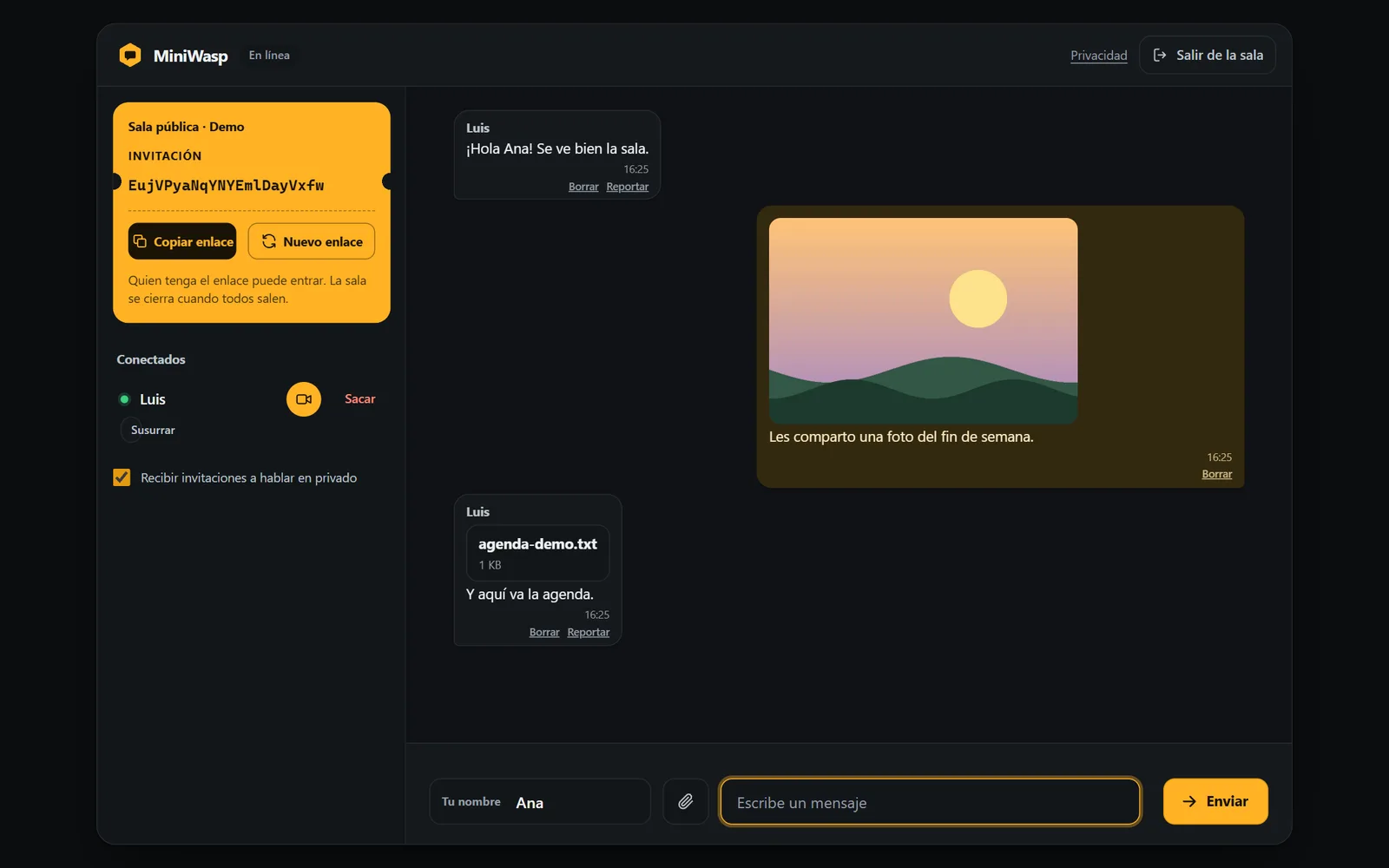
Chat and video calls with no accounts or phone numbers. Everything lives in memory and files become unreadable when the room closes.
- Year
- 2026
- Context
- Academic project · Software Security, UTA
- Code
- GitHub
- automated tests, all green
- 709
- line coverage
- 98.75%
- E2E scenarios with two real Chrome browsers
- 14/14
- STRIDE threats, each with its test
- 39
The system
Temporary rooms of up to 20 people joined through an invitation link, public rooms with strict moderation, and one-to-one video calls. No accounts, no phone number and no database: rooms, messages and sessions live in memory and disappear when the room closes.
Architecture
Technical decisions
A single Node.js server serves the page, authenticates, moderates, encrypts and handles WebRTC signalling. Nothing that comes from the browser is trusted, and neither is the bucket provider: attachments only leave the process encrypted, and audio and video travel directly between the two browsers.
What it does
- Rooms behind a 128-bit invitation, for up to 20 people. Whoever creates the room can remove someone and renew the link.
- Public rooms listed on the home page with their title and occupancy, never names: strict moderation, a 2 s slow mode and bans stored as an HMAC fingerprint of the IP, never the IP.
- Whispers: from a public room to a private one for two, if the invitee accepts, with a single-use pass that expires in 60 seconds.
- Photos, voice notes, PDFs and text encrypted with AES-256-GCM and a per-room key. File types are recognised by their bytes, not their extension.
- Photos without EXIF or GPS: the browser redraws them and the server re-encodes them from the pixels, with limits against decompression bombs.
- On-server moderation of text and images: a normaliser undoes evasion tricks and nsfwjs checks photos in worker threads. If the workers don't answer, the photo isn't published.
- One-to-one video calls over WebRTC (DTLS-SRTP), with a 12-digit safety code derived from the DTLS fingerprints to detect interception.
- CSP without
unsafe-inline, COOP and COEP, HSTS, anHttpOnly,SameSite=Strictcookie of which the server only keeps the hash, andOriginchecks against CSRF. - A REST API (
/api/v1) with the same rules as the browser. - 709 tests with
node:testand jsdom (98.75% line coverage), 14 E2E scenarios with two real Chrome browsers, and OWASP ZAP with no alerts against production.
One concrete problem
Deleting is easier if you can never read
Attachments had to live in an external bucket, and I couldn't trust the provider to really delete them when a room closed. Each room has a random AES-256-GCM key that only exists in the server's memory, with room:attachment as associated data so an object can't be moved to another room. When the room closes, the key is overwritten with zeros: any copy left at the provider is noise.
Screenshots
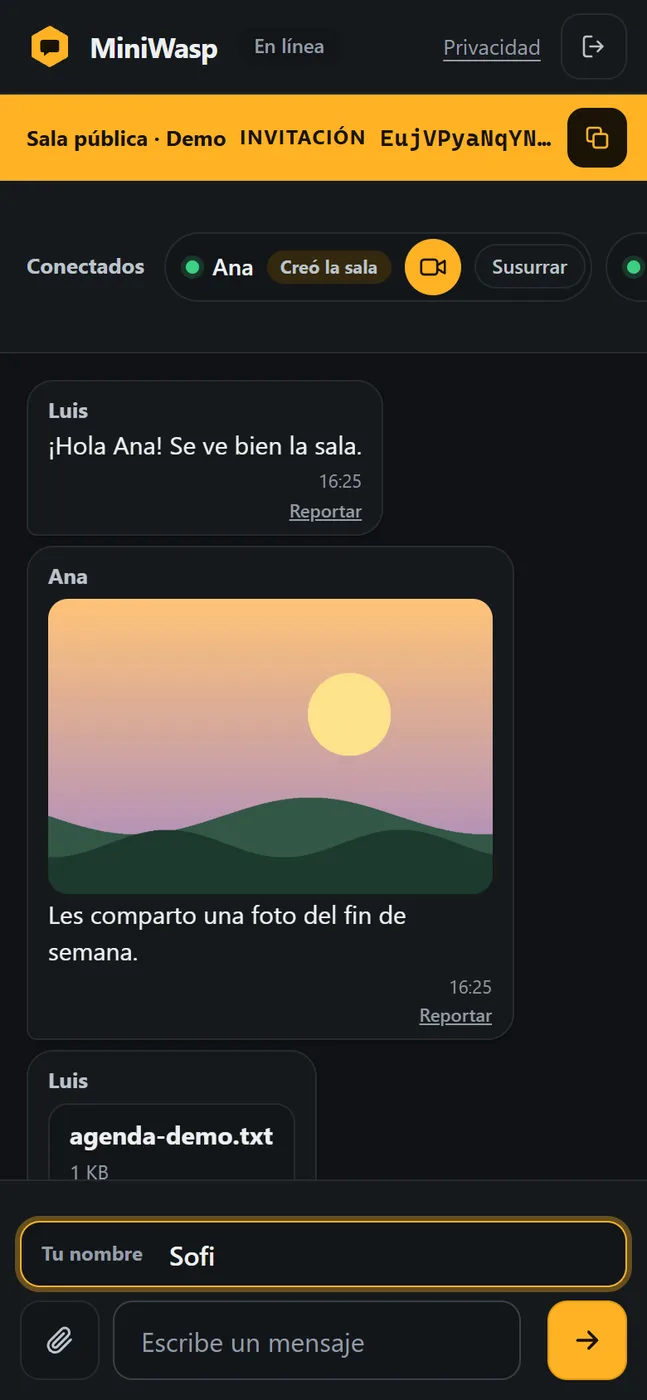
The home page: create a room, join with an invitation or pick a public room. A public room with a photo checked by the on-server AI and re-encoded without metadata. The people are fictional. The private-chat invitation Luis receives, next to the list of people online with “Whisper”. Strict moderation rejects an insult before it's published. The home page on a phone. The room on a phone, with the participant strip.
My part
The whole project, on my own: the STRIDE threat model (39 threats, each with its control and its test), the framework-free server and client, moderation, testing and the Railway deployment with Docker.
ScopeStated limitations: without a TURN server some networks block the call, a 20-person video call would need an SFU, and moderation can't look inside voice notes or PDFs, which is why public rooms don't accept them.
Stack
- Node.js
- WebSocket (ws)
- WebRTC
- TensorFlow.js (WASM)
- nsfwjs
- AES-256-GCM
- Amazon S3
- Docker
- Railway
- node:test
- Playwright
- OWASP ZAP