Accounting module · Miñarica Water Board
Double-entry accounting for a community water board
Double-entry accounting with journal entries, periods, a chart of accounts, receivables and six PDF reports.
- Year
- 2026
- Context
- Miñarica Water Board · DIVISO outreach programme, UTA
- Code
- Private code
- official accounting reports in PDF
- 6
- checked before each entry is saved
- debit = credit
- entry types: income, expense and general
- 3
The system
Our team digitised the Miñarica Water Board's accounts in a UTA outreach project (DIVISO). My module turns invoices into accounting records and financial statements.
Architecture
Technical decisions
The code requires debits and credits to balance and each new account to have a valid parent. It blocks changes to closed periods and allows deletion only for pending entries in open periods.
What it does
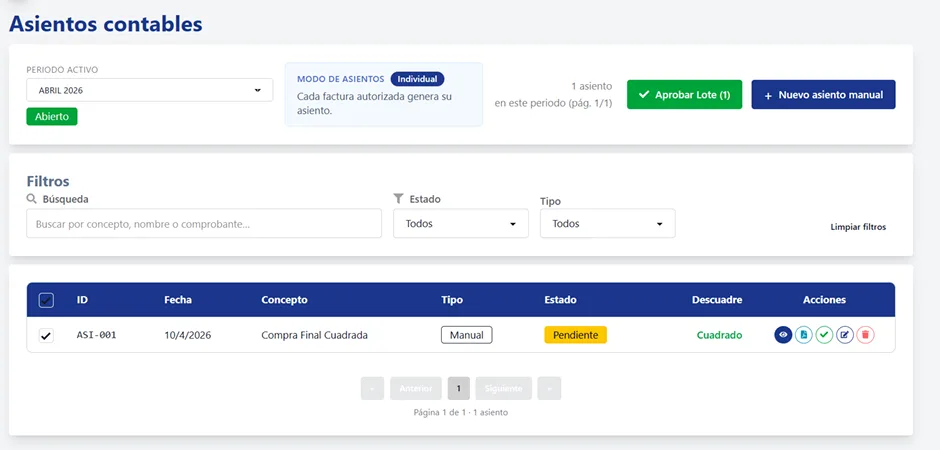
- Income, expense and general journal entries: filter, approve, edit and delete (only pending ones in an open period).
- Each entry's detail totals debits and credits and shows the imbalance, if any.
- A manual entry isn't saved unless debits equal credits.
- Open or closed periods: a closed period can no longer be modified.
- Six official PDF reports: General Journal, General Ledger, Trial Balance, Balance Sheet, Income Statement and Accounts Receivable, plus a voucher for each entry by type.
- Hierarchical chart of accounts that detects the parent account from the code.
- Accounts receivable with partial payments and payment history.
One concrete problem
A chart of accounts with no orphans
In accounting, an account's code already says where it belongs: 100.1.1 hangs from 100.1, which hangs from 100. Instead of asking the user to pick the parent from a list, the form works it out from the code as it's typed. If the parent doesn't exist, it warns and blocks saving: the chart never has loose accounts that later throw the General Ledger out of balance.
Screenshots
Journal entries: filters by period, type and status, and approval. An entry's detail, with total debits, total credits and the imbalance. Manual entry: it isn't saved unless debits equal credits. Period detail, with its invoices, purchases, entries and reports. The period's General Journal. General Ledger by account, with balances. Trial Balance: totals and balances that add up. Income Statement: revenue, expenses and profit. The hierarchical chart of accounts. New account: the parent is detected from the code. A test customer's receivable, with partial payments and history.
My part
The accounting module: the NestJS and Prisma backend and its React screens. Journal entries, periods, chart of accounts, receivables and reports.
ScopeThe team also built e-invoicing compliant with Ecuador's tax authority (SRI), along with tools to manage customers, branches and meter readings. The handover included staff training.
Stack
- NestJS
- TypeScript
- Prisma
- MySQL
- JWT
- React
- Tailwind CSS