Fiado
Live face verification for a credit union
A loan and investment simulator. I built identity verification, the phone handoff, sign-up, sign-in and the landing page.
- Year
- 2026
- Context
- Academic project · Engineering Economics for Software, UTA
- Team
- 6 people
- Code
- Private code
- random gestures, drawn by the server
- 2 of 3
- continue on the phone, live on the computer
- QR + SSE
- unit tests for the biometrics module
- 30
- facial landmarks to check each gesture
- 68
The system
Fiado simulates loans with French or German amortization, generates PDF schedules and accepts fixed-term investment applications. Applicants verify that they are the ID card holder before opening an investment.
Architecture
Technical decisions
Detection in the browser only guides; the server decides. The client asks for two random gestures, guides the person with the oval and sends a frontal frame, one per gesture and a closing frontal one. The server checks that they are all the same person, that each gesture was made and that the face matches the one on the ID: a photo or a pre-recorded video won't pass. And recognition sits behind an interface (BiometricProvider): swapping face-api for a commercial provider leaves the rest untouched.
What it does
- After signing up, the account exists but can't operate until a live face matches the ID card photo. After five failed attempts it locks, and an administrator unlocks it.
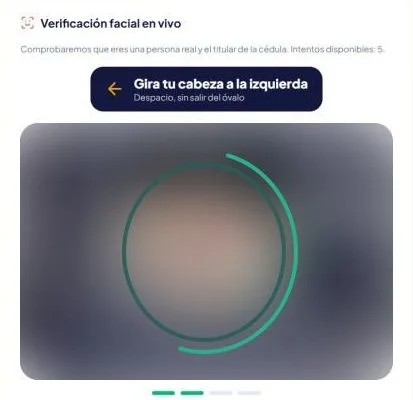
- Challenge-response liveness: the server draws two of three gestures (turn left, turn right or smile) in a single-use session that expires in three minutes.
- face-api runs in the NestJS backend on WebAssembly, with no GPU or native binaries, and checks each gesture on the frame's 68 facial landmarks.
- The ID match uses 128-dimension face descriptors. The threshold and attempts are configurable, and every attempt is audited with its scores and the reason for a rejection.
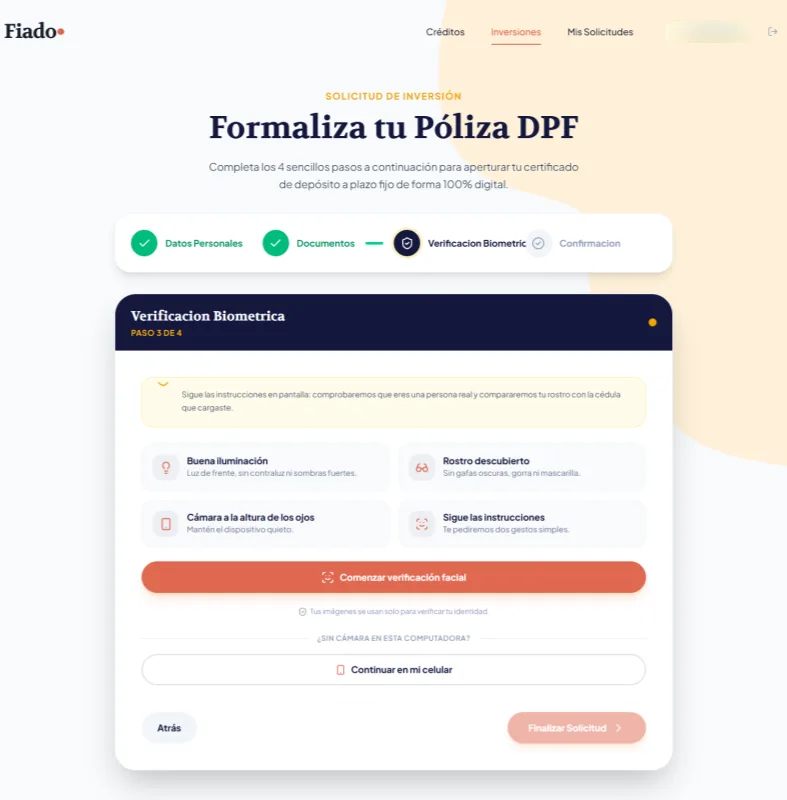
- Without a camera, you continue on your phone through a ten-minute QR code. The computer sees live, over Server-Sent Events, which step the phone is on and whether it was closed (a heartbeat every two seconds). Tokens are stored as SHA-256.
- The same verification covers sign-up, investment applications and password recovery.
- Sign-up and sign-in with httpOnly cookies. The refresh token rotates on every renewal, and reusing an already-rotated one revokes its whole family: a stolen cookie doesn't outlive its owner. Passwords use scrypt from
node:crypto, with no native dependencies. - The landing page shows a real simulation (French system) and the products from the API, with scroll reveals that respect reduced motion.
- 30 unit tests for the module (the gesture metrics and the provider with real faces) and e2e tests for the whole flow, with a deterministic simulated provider.
One concrete problem
Two faces on one ID card
The first version required exactly one face per image and rejected almost every ID card: the Ecuadorian one carries a smaller ghost portrait next to the main one, and photos sometimes arrived rotated. Now the largest face on the card is used, the photo is straightened if no face shows up, and the descriptor comes from a full-resolution crop of the portrait, not the downscaled image. On the selfie, a second face only invalidates the capture if it is clear and close in size to the main one: a picture on the wall or someone walking behind no longer breaks the verification.
Screenshots
Step 1: the ID card photo, with what to do and avoid, and consent for the biometric data. Liveness check: the server asked to turn the head left. The face is blurred on purpose. Identity confirmed: the account can now operate. Verification inside an investment application: tips before starting and the option to continue on a phone. Verification passed, with the match against the ID card. The landing page: a real loan simulation and the verified-identity badge.
My part
The biometric flow end to end: the biometrics module in NestJS and Prisma (liveness, face matching and attempt auditing), sign-up identity confirmation, the handoff to the phone with a QR code and Server-Sent Events, and their guided screens in Next.js. Also sign-up and sign-in with refresh-token rotation, and the site's landing page. In a team of six.
ScopeThe team built the loan and investment simulators, the PDF amortization schedules and the admin panel.
Stack
- NestJS
- Prisma
- PostgreSQL
- Next.js
- TypeScript
- face-api
- TensorFlow.js (WASM)
- Server-Sent Events
- Vitest
- Vercel
- Render